Phase 1 · Define
What a SIPOC is and how to build one, step by step
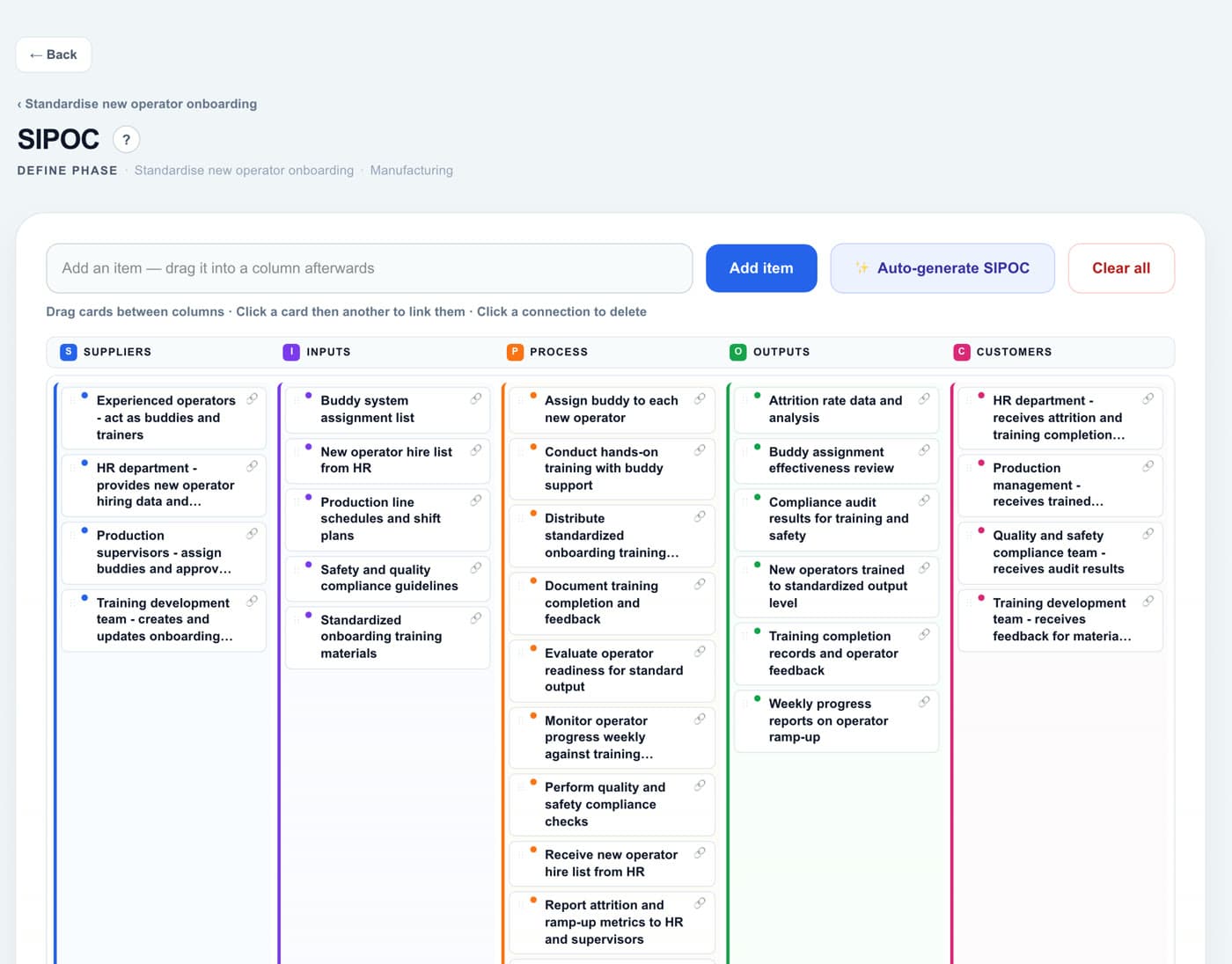
A SIPOC sums up a process on a single page: who provides what, which steps it follows and who receives the result. You build it at the start of an improvement project so the whole team talks about the same process.
In short
A SIPOC is a one-page, high-level map of a process that lists its Suppliers, Inputs, main Process steps, Outputs and Customers; it is used in the Define phase of DMAIC to agree where the process starts and ends.
What it is
SIPOC stands for the diagram's five columns: Suppliers, Inputs, Process, Outputs and Customers.
It is not a detailed map: the process is described in four to seven high-level steps. Its value lies in fixing where the process starts and ends, and in making visible the suppliers and customers that are easily forgotten.
When to use it
- At the start of a DMAIC project, in the Define phase, before measuring anything.
- When several departments have a different idea of what the process includes.
- As a first step before a more detailed value stream map (VSM).
How to do it, step by step
- 1Name the process and mark its boundaries. Write down where it starts (the first trigger) and where it ends (delivery to the customer). Anything outside stays outside.
- 2Write the main steps. Four to seven, each a verb and an object: “Receive the order”, “Prepare the material”. No detail yet.
- 3List the outputs and who receives them. What the process produces and for whom. Customers can be internal.
- 4List the inputs and where they come from. Materials, information or resources the process needs, and who provides them.
- 5Review it with the people who do the work. Walk through it with the people in the process. If they do not recognise it, something is missing.
Worked example
Case: a plant that wants new operators to reach standard output sooner.
| SSuppliers | IInputs | PProcess | OOutputs | CCustomers |
|---|---|---|---|---|
| HR | List of new hires | Receive the list of new operators | Qualified operator at their station | Production manager |
| Training | Training material | Assign a buddy | Completed training record | Production line |
| Experienced operators | Work instructions | Train at the workstation | Skills assessment | HR |
| Assess competence | ||||
| Release to production |
Common mistakes
- Describing the process in too much detail: that is what the value stream map is for.
- Starting with the suppliers instead of the process and the customers.
- Forgetting internal customers, who often feel the problem most.
- Building it at a desk without the people who do the work.
Frequently asked questions
What is the difference between a SIPOC and a value stream map?
A SIPOC fixes the scope of the process in four to seven steps. A value stream map comes later and details every step with its times, stock and waiting.
How many process steps should a SIPOC have?
Between four and seven. More than that turns it into a detailed map, which is not its job.
Who should take part in building it?
The people who do the work, plus someone who knows the main suppliers and customers. They are the ones who notice what is missing.