Phase 2 · Measure
The 8 wastes of Lean: how to spot them in a process
The 8 wastes are the forms that work without value takes in any process. Learning to name them is the first step towards measuring them and choosing which one to remove first.
In short
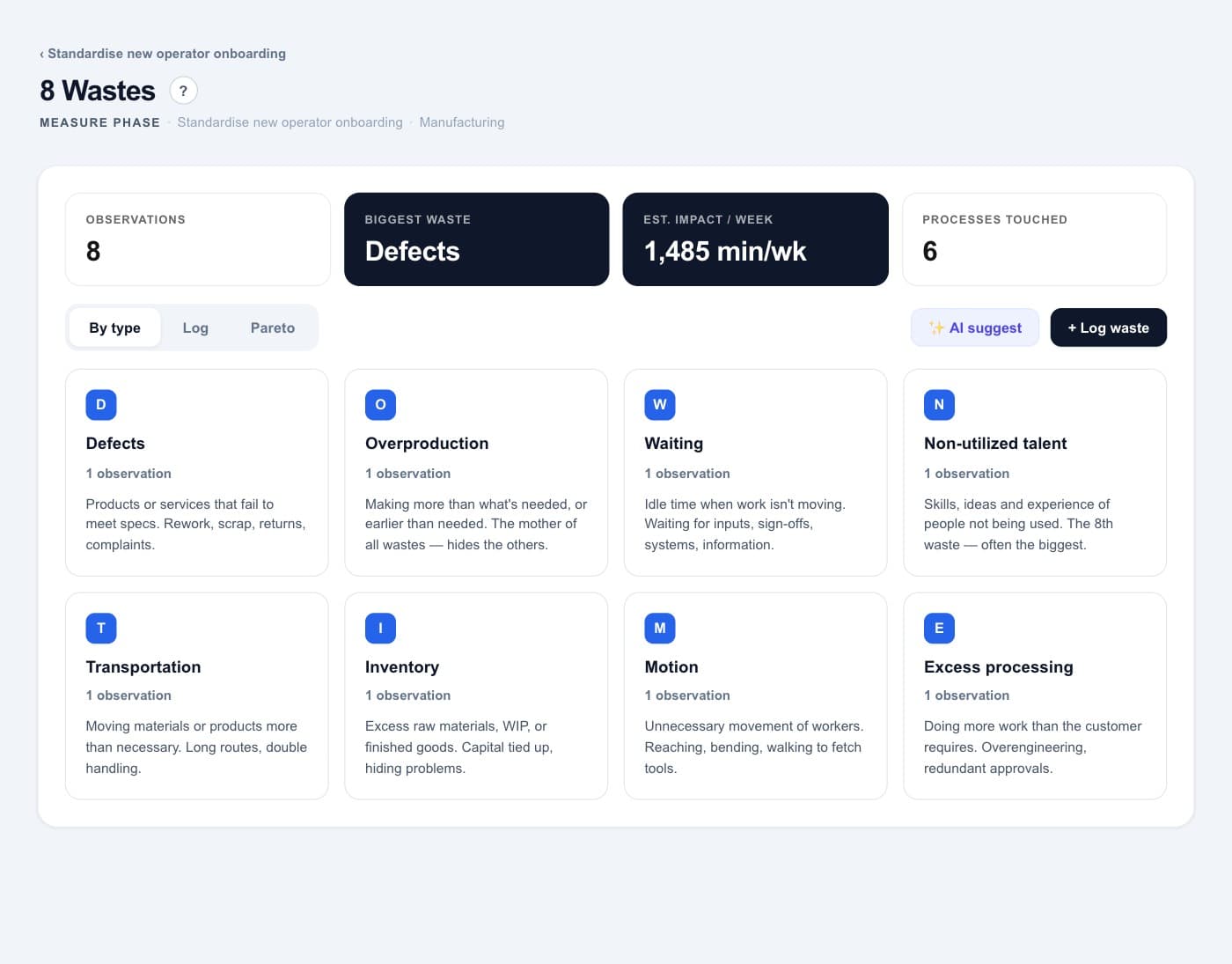
The 8 wastes of Lean (muda) are the kinds of activity that consume time or resources without adding value for the customer: defects, overproduction, waiting, non-utilised talent, transportation, inventory, motion and excess processing. Their initials spell DOWNTIME, which makes them easy to remember.
What it is
The first seven come from the Toyota Production System; non-utilised talent was added later, when Lean spread beyond Toyota. They apply to offices and services as much as to the shop floor: a form that waits for a signature is inventory, and a report nobody reads is overproduction.
The list is a way of looking, not a form to fill in. You walk the process, write down what you see under the waste it belongs to, and estimate how often it happens. Some of it cannot be removed straight away, such as a required safety check, but it can still be reduced.
When to use it
- In the Measure phase, to see where the process loses time before deciding what to analyse.
- On a gemba walk, to give the team a shared vocabulary for what it observes.
- When a process feels slow but nobody can say exactly where the time goes.
How to do it, step by step
- 1Choose the process and its boundaries. The same one as in the SIPOC: where it starts and where it ends. Waste outside those limits waits for another project.
- 2Go and see the work. Watch the process where it happens, with the people who do it. Wastes are hard to see from a meeting room.
- 3Write down each observation as a fact. What happens, where and how often: “waits 40 minutes for a free practice station”, not “there is a lot of waiting”.
- 4Assign each observation to one waste. If it fits two, choose the one that best explains the time lost. The point is the observation, not the label.
- 5Estimate the frequency or the time lost. A rough figure is enough to compare. With it you can build a Pareto chart and decide where to start.
Worked example
Case: a plant that wants new operators to reach standard output sooner.
| Waste | What it looks like in the case |
|---|---|
| Defects | Parts made by new operators are rejected at inspection and reworked by the buddy. |
| Overproduction | A full induction pack is printed for each new hire; most of it is never read. |
| Waiting | The new operator waits at the station until someone is free to show the next task. |
| Non-utilised talent | Experienced operators’ tips never reach the work instructions. |
| Transportation | Sample parts are carried to the quality office for every skills check. |
| Inventory | Skills sign-off forms pile up on the supervisor’s desk, weeks behind. |
| Motion | The new operator walks to the office to find the right instruction for each job. |
| Excess processing | The same safety induction is given three times: by HR, the supervisor and the buddy. |
Common mistakes
- Trying to find something for all eight wastes: the list helps you look, it is not a quota.
- Blaming people for waste: it almost always comes from how the process is designed.
- Recording opinions (“training is chaotic”) instead of observations that can be checked.
- Attacking every waste at once instead of measuring them and starting with the largest.
Frequently asked questions
What are the 8 wastes of Lean?
Defects, overproduction, waiting, non-utilised talent, transportation, inventory, motion and excess processing. Each is a kind of activity the customer would not pay for.
What does DOWNTIME stand for?
It is a mnemonic formed by the initials of the eight wastes in English: Defects, Overproduction, Waiting, Non-utilised talent, Transportation, Inventory, Motion and Excess processing.
What is the difference between muda, mura and muri?
Muda is waste, activity that adds no value. Mura is unevenness in the workload, and muri is overburden on people or equipment. The three are related: unevenness and overburden tend to produce waste.