Phase 3 · Analyse
The 5 Whys: how to reach the root cause
The 5 Whys means asking “why?” several times in a row, each time about the previous answer, until you reach a cause you can act on. It is the simplest way not to stop at the symptom.
In short
The 5 Whys is a root-cause technique: you ask “why?” repeatedly, usually about five times, each answer building on the previous one, until you reach a cause that a concrete action can remove.
What it is
Five is a guide, not a rule: sometimes three questions are enough and sometimes you need six. You stop when the answer is a cause the team can change.
It works best on specific, well-defined problems. For problems with many causes, combine it with an Ishikawa diagram.
When to use it
- In the Analyze phase, to dig into the most likely causes.
- When a problem keeps coming back even though it “was fixed”.
- In short meetings, without needing complex data.
How to do it, step by step
- 1Describe the problem with facts. What happens, where and how much. No blame.
- 2Ask why it happens. And write the answer as it is, with facts that can be checked.
- 3Ask why about that answer. Repeat until you reach something the team can change: a method, a rule, a resource.
- 4Check the chain backwards. Read from the cause to the problem with “and that is why…”. If a step does not hold, revise it.
- 5Define an action on the root cause. With an owner and a date. And an indicator to know whether it worked.
Worked example
Case: a plant that wants new operators to reach standard output sooner.
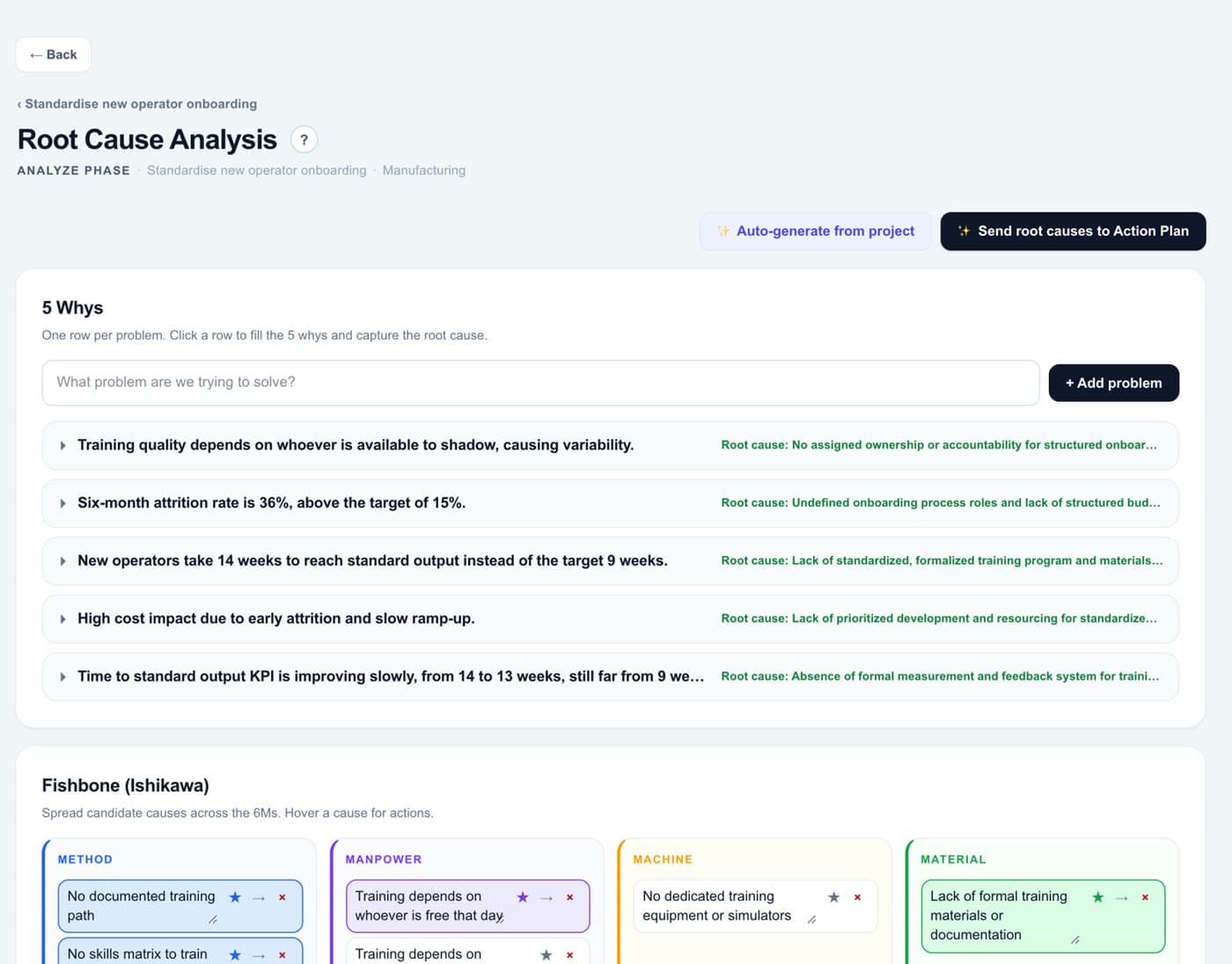
Six-month attrition among new operators is 36% (target: 15%).
✓ There is no standard onboarding process with a fixed buddy.
→ Assign a fixed buddy for the first eight weeks and review progress every week.
Common mistakes
- Ending on a person (“because John did it wrong”): the root cause is almost always a process.
- Answering with assumptions instead of facts.
- Stopping too early, at something nobody on the team can change.
- Following a single path when several causes act at once.
Frequently asked questions
Does it always take five whys?
No. Five is a guide: stop when you reach a cause that a concrete action can remove, whether that takes three questions or seven.
What is the most common mistake?
Stopping at a person, such as “operator error”. Ask why the process allowed the error to happen.
Can the 5 Whys handle several causes?
Yes: split the chain when one answer has two causes, or start from an Ishikawa diagram and run the 5 Whys on each likely cause.