Phase 4 · Improve
The improvement action plan: how to write one, step by step
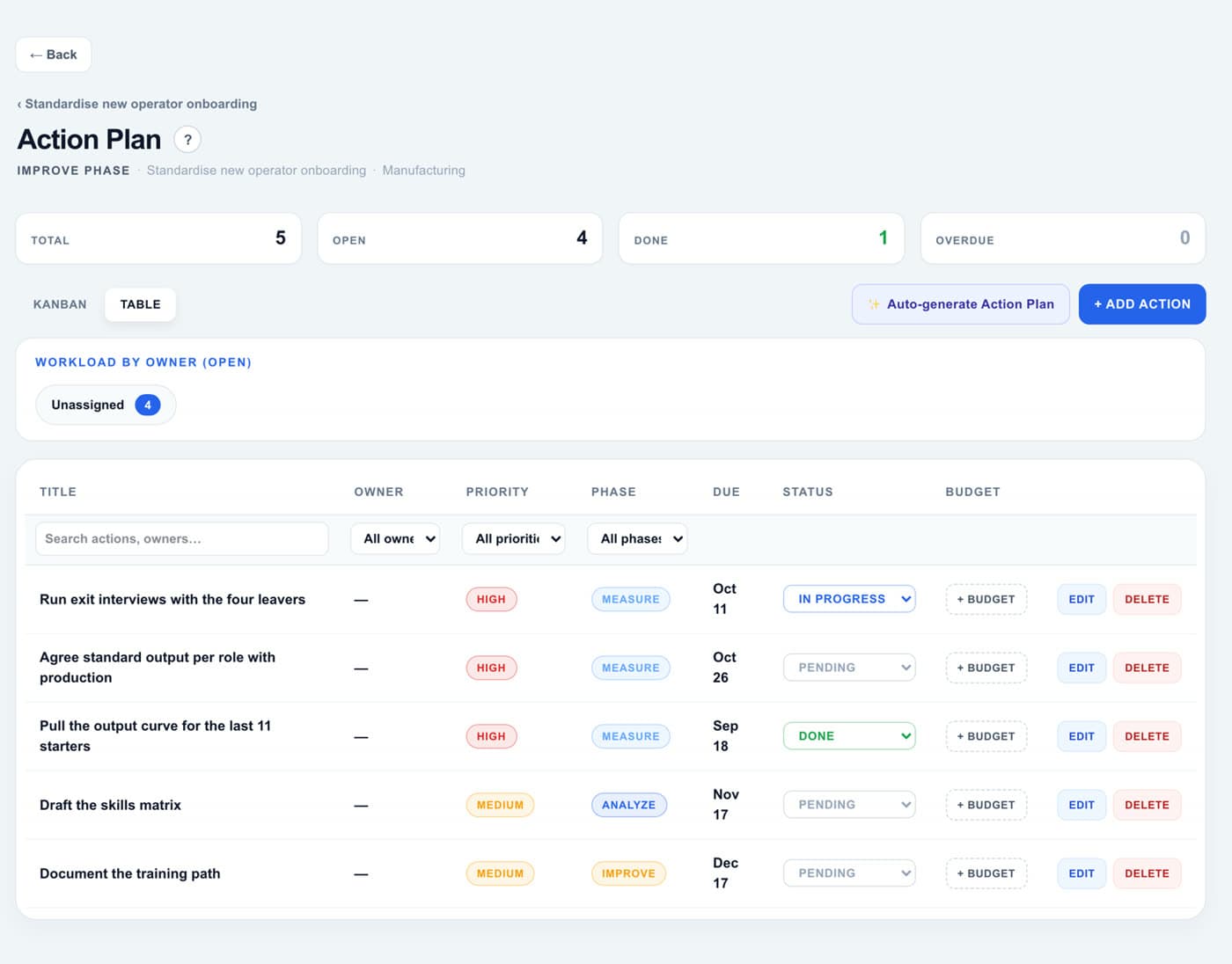
The action plan turns the analysis into work. Each action has one owner and a date, and is tied to the root cause it removes and to the KPI that will show whether it worked.
In short
An improvement action plan is the list of actions that will remove the verified root causes of a problem, each with one owner, a due date, the root cause it addresses and the KPI it should move. It turns the analysis into work that can be followed up and checked.
What it is
It is a table, not a document: one row per action. The two links are what set it apart from a to-do list: back to the root cause, so no action is there just because it sounded good, and forward to the KPI, so you can tell whether it made a difference.
It lives through the Improve phase. You review it every week, actions are closed when they are done, and the plan is judged on the KPI, not on how many rows are ticked.
When to use it
- In the Improve phase, once the root causes have been checked with data.
- When several people have to act on the same problem and the work needs to be visible.
- When a project has many ideas and needs to decide which ones to carry out.
How to do it, step by step
- 1Start from the verified root causes. Not from every cause on the Ishikawa diagram: only the ones the data or the 5 Whys confirmed.
- 2Write each action as a concrete task. A verb and a result that can be seen when it is done: “Reserve one practice station per line”, not “Improve training”.
- 3Give each action one owner. One person, named by role, who answers for it. Not a department and not “the team”.
- 4Agree a realistic due date with the owner. A date the owner accepts, not one imposed. Long actions are split into steps with their own dates.
- 5Link each action to its root cause and its KPI. If an action has no root cause, question it. If it moves no KPI, you will not know whether it worked.
- 6Review the plan every week. What is done, what is late and why. When the actions are closed, check that the KPI has moved.
Worked example
Case: a plant that wants new operators to reach standard output sooner.
| Action | Owner | Due | Root cause | KPI |
|---|---|---|---|---|
| Assign each new operator a fixed buddy on their own shift for the first eight weeks | Production manager | 2 June | The buddy changes with the shifts | Six-month attrition |
| Review each new operator’s progress every week against the training path | Training manager | 2 June | Each operator’s progress is not measured | Six-month attrition |
| Write a training path for each station, in the order the skills are learnt | Training manager | 16 June | No documented training path | Weeks to standard output |
| Set aside two hours of trainer time per shift in the production plan | Shift supervisor | 16 June | Trainers have no time set aside | Weeks to standard output |
| Reserve one practice station per line during training hours | Production manager | 30 June | Practice stations taken up by production | Weeks to standard output |
| Update the work instructions with two experienced operators | Process engineer | 14 July | Out-of-date work instructions | Weeks to standard output |
Common mistakes
- Actions with no root cause behind them, added because they seemed a good idea.
- An owner who is “everyone”, a department or a committee: then nobody answers for it.
- Vague actions (“improve communication”) that can never be said to be finished.
- Closing the project when every action is done, without checking that the KPI has moved.
Frequently asked questions
What should an improvement action plan include?
For each action: what will be done, who owns it, by when, which root cause it addresses and which KPI it should move. A status column helps the weekly review.
Is an action plan the same as 5W2H?
5W2H is a checklist for describing an action: what, why, where, when, who, how and how much. An action plan uses its core questions, with “why” answered by the root cause and the KPI.
How often should an action plan be reviewed?
Weekly is a common rhythm during the Improve phase, in a short meeting with the owners. Late actions get a new date and a reason, not a silent change.